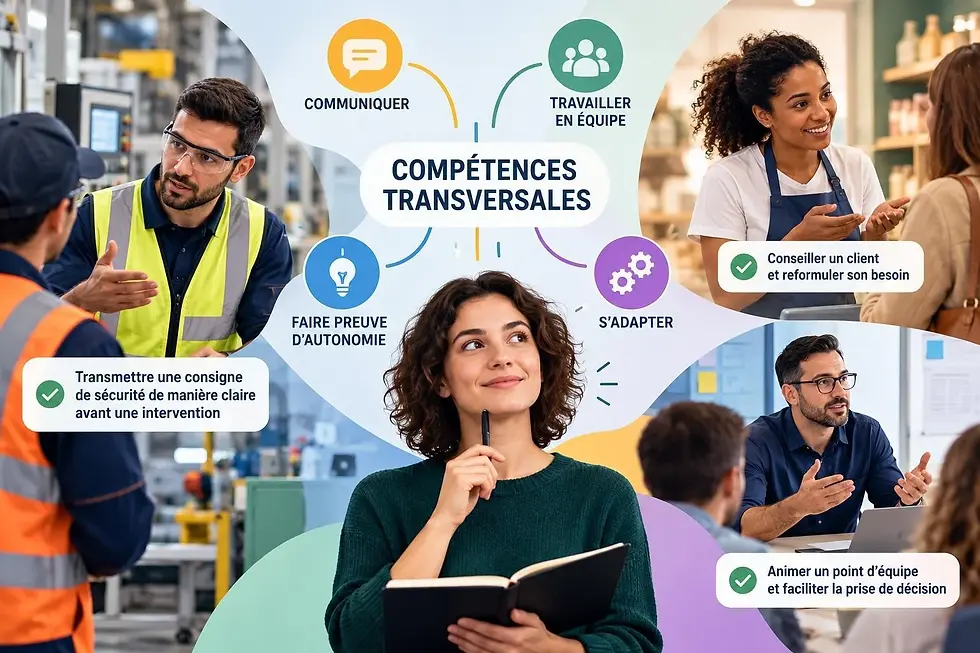
At Orange, recognizing skills developed on the job

At Orange, the École des Métiers Techniques (Technical Trades School) trains and upskills employees of Orange France’s Technical Division, a total of 19,000 people.
The starting point was a simple conviction, championed by its director Ahmed Kabèche: take skills development beyond the training room and give formal recognition to what is already being learned on the job, sometimes informally.
With this in mind, Orange turned to Daylindo, a platform for managing and developing operational skills, to structure the shift from required skills to skills actually acquired in real work situations.
After more than three years of collaboration between Orange and Daylindo on developing skills in the workplace, a first project to recognize learning through Open Badges was launched for internal trainers, especially those trained through the Cnam. Between two training sessions, these trainers carried out significant work in the field that had never been recognized until then: only official training hours were taken into account.
With Daylindo, this between-session work was structured as on-the-job training: the required skills were identified, their development was organized at the workstation, a reflective phase was set up with the trainer, and skill mastery was then assessed by a jury using precise evaluation grids. Completion of the program could then be recognized with an Open Badge issued through BCdiploma.
Other projects followed the same principle. For occasional trainers, 25 hours of previously invisible work were recognized and valued. For Skills Development Partners, 50 additional hours were taken into account.
The same approach was then extended to technicians, particularly for activities requiring electrical certifications. Without replacing the certification itself, Daylindo makes it possible to identify and assess the operational skills technicians use in the field. Observed and validated by subject-matter experts, these skills are linked to the skills framework and make visible a body of know-how that is genuinely mastered.
For just over a year, the same principle has also shaped internal career transition programs. Daylindo brings together, in a single approach, the expected skills, the activities used to develop them and the assessment of know-how acquired in real situations. More recently, Orange has also started working on mentoring, to better structure and make visible the transfer of skills between colleagues, which until now happened largely informally.
The system keeps evolving. Orange is currently reworking its job skills frameworks, task by task, with several levels of mastery. Linked to the observations and assessments carried out in the field, these frameworks are gradually building a clear map of operational skills that everyone can use, from managers to employees themselves: not only what each position requires, but also what each person actually masters.
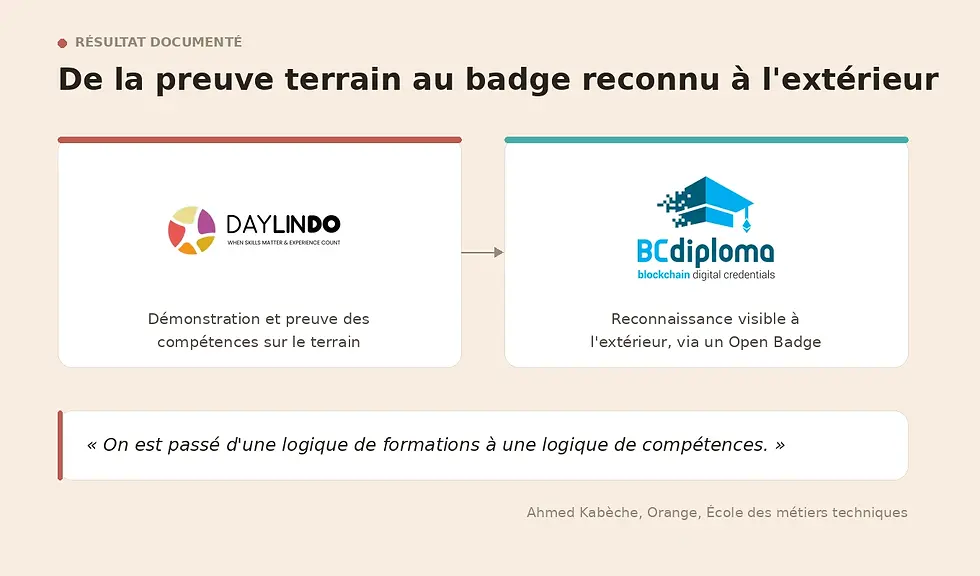
“We moved from a training-based approach to a skills-based approach.”Ahmed Kabèche, Director of the École des Métiers Techniques, Orange
This shift illustrates a key difference between completing a training course and developing a skill that can truly be applied at work.
“An operational skill is neither a completed training course nor a self-reported skill. The challenge is to start from what people really need to know how to do, develop those skills at the workstation and validate mastery in real situations. That is how you produce skills data that is reliable and useful to the company.”
Gerardo Marcotti, President of Daylindo
Daylindo organizes the development, observation and validation of operational skills in real work situations; BCdiploma then turns this validation into verifiable, shareable digital proof.
This continuity is now in place at Orange thanks to the integration between Daylindo and BCdiploma.
Once skills have been validated against the defined criteria, particularly through a “jury” mode, the information is automatically sent to BCdiploma. The badge is then issued and added to the learner’s skills portfolio in Daylindo.
It serves as verifiable, shareable digital proof of the skills acquired and validated throughout the program.
This recognition goes beyond simply certifying that a skill has been validated. It also specifies the context, the criteria used to assess it, and allows a third party to verify its authenticity.
This is precisely BCdiploma’s role. The platform formalizes validated skills in secure, shareable digital proof. Thanks to its patented blockchain technology, the related information can be verified independently and remains accessible over time, without depending on a third-party platform. It can include the issuer, the award criteria, the skills concerned and the supporting evidence.
This approach goes beyond simply tracking training. It becomes possible to document what a person can actually do, in what context the skill was developed, how it was observed and against which criteria mastery was validated. The proof can then be viewed and shared by its holder.
For organizations, this ability to develop, objectify and then recognize skills helps transform how career paths are managed. Skills developed directly on the job no longer stay locked in frameworks or internal tools: they can be added to an up-to-date map of acquired skills, then recognized and valued beyond the context in which they were developed.
The complementarity between Daylindo and BCdiploma makes full sense in this continuity: Daylindo links required skills to real work, structures their development on the job and makes it possible to observe and validate mastery; BCdiploma extends this validation with reliable, verifiable and shareable digital proof.
“Completing a training course tells you about a path. Demonstrating a skill takes you further. Our role is to make sure that a validated skill can be recognized beyond the context in which it was acquired, thanks to reliable, verifiable and shareable proof.”
Luc Jarry-Lacombe, CEO of BCdiploma