Workplace mentoring: tracking and recognizing knowledge transfer


In short
In most organizations, workplace mentoring already happens every day, without being counted or recognized. One colleague shows another how to do a task, a manager explains a procedure, an expert passes on a hands-on skill. This page explains how to capture what really happens in these work situations to bring this “grey” training out of the grey zone, in other words to give proper recognition to informal training that already exists, rather than trying to replace it with a new program. It details what concretely changes when this knowledge transfer is captured, and why it secures both critical know-how and onboarding paths.
1. An hour of knowledge transfer that counts for no one
An employee calls a more experienced colleague and asks her to show him how to handle a specific tool or task. She takes the time to explain, to go through the steps again with him, and to answer his questions. An hour goes by. No one assesses it, no one records it, and at the end of the day, that hour does not exist in any system.
This is the most common form of workplace mentoring: real, useful knowledge transfer, but completely informal. It is what can be called “grey” training: it does take place, but it stays off the organization’s radar. It never makes it into a skills portfolio or a training plan, and if the person delivering it changes roles or leaves the organization, the know-how they were passing on disappears with them. This especially affects critical know-how that needs to be secured, the kind that relies on one person’s experience and is not documented anywhere.
2. Mentoring stays informal, what you capture from it changes everything
This is not about pitting two types of mentoring against each other, as if one had to replace the other. By nature, mentoring remains a spontaneous form of knowledge transfer: you show, you explain, you answer questions. That is what makes it quick and natural, and that is not what needs to change.
What changes is the information captured around this knowledge transfer that is already happening. By linking each session to an identified skill, noting what was observed and understood, and keeping a usable record, you turn an oral, invisible, “grey” transfer into one that is out of the grey zone: recognized, recorded and defensible. The nature of mentoring does not change; its status within the organization does.
This capture can happen as the work situation unfolds, with no need to design a heavy training program upfront. That is exactly what sets this approach apart from a full AFEST program (on-the-job training, as defined in French regulations), which is designed and planned in advance: here, you start from what already exists in the field and make it visible, rather than building a new program from scratch.
That said, once these mentoring sessions are properly captured and recorded, some of them can meet the criteria that allow informal training hours to be recognized.
3. What concretely changes when mentoring is captured
Capturing mentoring does not mean adding paperwork to a natural practice, or turning it into a training session planned in advance. It is done simply, after the knowledge transfer, in a few minutes:
An identified skill that the session is linked to, defined before the transfer when possible, or simply recognized right after when the mentoring came from a spontaneous need.
A starting point and an end point, even informal ones: what the mentee could do before, and what they can do after the session.
A sign that the skill has been taken on board, a trace of reflection, often a short conversation, which lets the mentee rephrase what they understood and identify what still needs to be consolidated.
A record of the acquired skill, kept in a skills portfolio, linking this mentoring session to a specific skill and level of mastery.
It is these four lightweight elements, captured without weighing down the knowledge transfer itself, that move it from “grey” to recognized: usable in an audit, for internal certification, or simply to show that an employee truly masters a hands-on skill.
4. Mentoring as a building block of a wider skills system
A single mentoring session has limited value if it is not part of a consistent skills framework. It is by linking each mentoring session to an identified skill, itself tied to a job and a level of mastery, that the whole thing makes sense.
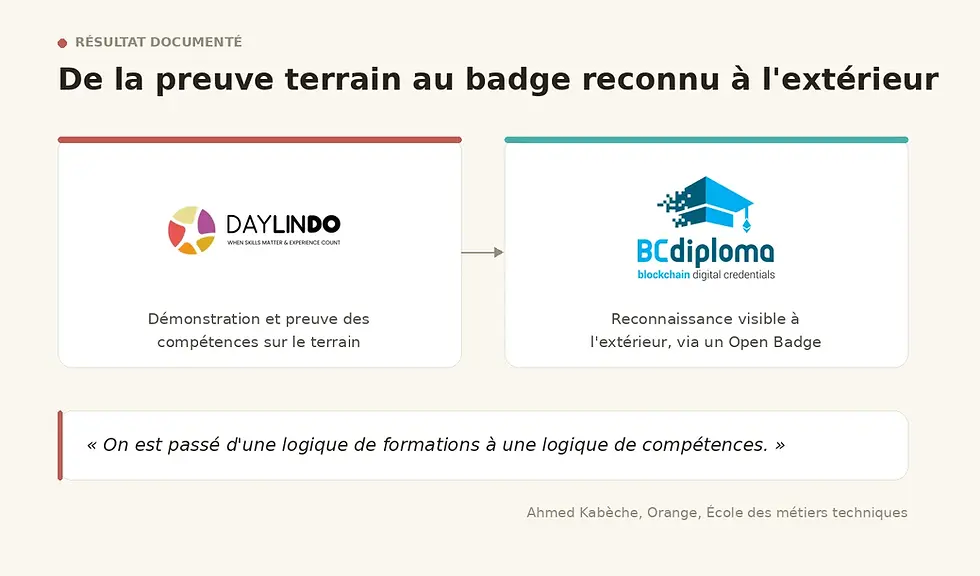
This logic applies both to recognizing informal training hours and to building career transition paths, where the hands-on part relies heavily on on-the-job mentoring sessions, alongside theoretical input and in-person sessions. It also applies to skills badges, which provide external recognition of what has been validated internally through several mentoring and assessment sessions.
In organizations spread across several sites, this structure becomes even more useful, as it helps maintain consistency between teams that do not all share the same field practices, a well-known challenge for heterogeneous multi-site networks.
5. Why capturing mentoring saves time instead of wasting it
The most common objection is time: capturing mentoring would supposedly take longer than simply showing how to do something. In practice, the knowledge transfer time does not change, since it is already happening. What is added is the time it takes to make it visible and usable afterwards: a few minutes, not a new session.
This visibility has a direct impact on onboarding new hires. A large share of the time lost when starting a new job comes precisely from know-how passed on orally and never recorded, which has to be explained again to every new recruit. Capturing mentoring means building on, once and for all, a knowledge transfer that would otherwise be repeated endlessly without ever leaving a usable record, an issue covered in detail on the page dedicated to high turnover and costly onboarding.
What Daylindo brings
Daylindo makes it possible to link each mentoring session to a specific skill in the job skills framework, with a starting point, an end point and a reflection phase captured as the work situation unfolds, before, during or just after, depending on what the field allows. The platform automatically tracks the time spent, links these sessions to the other building blocks of the skills system (badges, portfolio, skills map), and makes everything usable for an audit, recognition or internal certification, without adding to the workload of the person passing on their know-how.
FAQ
What is workplace mentoring?
Workplace mentoring refers to a situation where one employee passes on know-how, a procedure or a hands-on skill to another, usually in a direct and spontaneous way. It can remain informal, and therefore invisible to the organization, or be captured and linked to an identified skill.
What is the difference between informal mentoring and mentoring that is captured and recognized?
Mentoring itself does not change in nature: it is always direct knowledge transfer between two people. What changes is that captured mentoring is linked to a specific skill, accompanied by a short reflection on what was learned, and kept as a usable record. It is this capture that brings training out of the grey zone: it becomes defensible proof rather than just an oral practice.
Does mentoring count as training?
Mentoring that is not captured is generally not recognized as a training activity in the regulatory sense. Mentoring that is properly captured and recorded, on the other hand, can be recognized and valued in the skills development plan, and gains value when the framework (identified skill, assessment, reflection phase) and traceability are in place.
How long does it take to capture a mentoring session?
The knowledge transfer time itself does not change, since it is already happening. What is added is linking the session to a skill and a short assessment, often a few minutes, which is enough to make the session traceable and usable afterwards.
Who can provide workplace mentoring?
Anyone with a skill to pass on can be a mentor, whether a subject-matter expert, a manager or an employee experienced in a specific task. The quality of the knowledge transfer does not depend on having trainer status, but on how clearly the target skill is defined and the framework set around the session.
How does mentoring fit with other skills programs?
Mentoring feeds the skills framework just like other forms of on-the-job training: it enriches the skills map, contributes to a badge or internal recognition, and secures critical know-how that currently relies on just a few people.
Want to structure mentoring in your organization and finally make skills acquired in the field visible and usable?
Talk to the Daylindo team to see how to build it into your practices.