Transversal skills vs technical skills: how to tell them apart without separating them


A transversal skill is defined by the scope in which it can be used, not by its content. It can be applied across several jobs or work situations, whereas a technical skill remains tied to a specific activity, process or position. On paper, the distinction seems simple.
It becomes far more demanding as soon as you need to build a job skills framework, train frontline teams, and above all prove that a skill is truly mastered and not just declared. This is precisely where most HR frameworks run out of steam.
They list transversal skills such as autonomy, team spirit or rigor, without ever linking them to an observable work situation. On-the-job trainers don’t have this problem: they can easily spot an employee who works autonomously at their station, even without an HR label to name it. The challenge is to connect these two levels, the HR concept and the field observation, so that a transversal skill becomes usable data rather than a quality listed on a job description.
Transversal skills: a definition that goes beyond soft skills
The French Ministerial Center for Human Resources Development (CMVRH) defines a transversal skill as a generic skill that can be used in a variety of work situations. France Stratégie takes a similar approach, built on situations actually encountered in jobs rather than on abstract labels.
A transversal skill can cover communication, teamwork, organization, use of digital tools, analyzing a situation, solving complex problems, adapting to change, following procedures or handling a situation under pressure. It therefore combines knowledge, know-how and interpersonal skills (or behaviors). Contrary to a common shortcut, it is not limited to soft skills alone.
The terms “cross-functional skills” and “transversal skills” refer to the same concept in most professional contexts. In an internal framework, the choice of term matters less than the precision of the chosen definition and its consistency across all positions.
Transversal and technical skills: two logics that combine in the same position
A technical skill remains tied to a specific activity, job, process or environment. It depends on the tools, standards and methods specific to that activity. A transversal skill, on the other hand, can be developed in different contexts and remain usable beyond a given position.
Transversal skills | Technical skills |
Can be used across several jobs or situations | Tied to a specific activity, process or position |
Can span several job families | Depend on the tools, standards and methods specific to the activity |
Developed in varied work contexts | Acquired through repeated practice of a task or procedure |
Assessed through observable actions | Assessed through tasks, results or technical knowledge |
France Stratégie points out that transversal skills cannot be separated from technical skills when analyzing a work situation.
Take a maintenance technician. Mastering a procedure on a given machine is a technical skill. Analyzing a breakdown, alerting production or organizing their intervention involves skills that can be used elsewhere. In real work, these two levels are activated together, never separately.
The line between transversal and technical is not a property of the skill itself: it depends on the level at which it is described. “Using a digital tool” is transversal; “entering a work order in the site’s CMMS” is technical. “Following a procedure” applies to almost every job; “applying the electrical lockout procedure” only makes sense for certain positions. The more precisely a skill is described, the more technical it becomes. So the real question is not which column to put it in, but how precisely to describe it so that it can be observed.
A job description that lists only technical skills gives an incomplete picture of what is expected. Conversely, a list of general qualities with no link to an activity remains unusable. The framework must answer three questions: which skill is expected, in which situation it must be used, and which behaviors or results show that it is.
Transversal and transferable skills: a distinction that is still unsettled
The two terms are often used interchangeably, but some institutional sources separate them. The CMVRH distinguishes transversal skills, which can be used across different job families, from transferable skills, which can be used in several jobs within the same job family. France Travail (the French public employment service) follows a similar logic in some of its content, linking transferable skills more directly to career mobility.
An employee who knows how to work in a team can use this skill in jobs that are very different from one another, which makes it a transversal skill. Mastery of a specific industrial process, on the other hand, can be transferred to a similar industrial position, while remaining dependent on the original technical context.
Terminology is not fully consistent across organizations. For a company, what matters most is setting a stable definition in its own framework, rather than looking for a universal standard that does not exist.
A transversal skill only has value when linked to a work situation
A transversal skill takes on operational meaning when it can be observed in a given situation. France Stratégie built its analysis on sixteen work situations that help identify these skills, including dealing with the public, using IT tools, working under pressure and driving a vehicle.
Take autonomy. In a framework, this skill often remains too vague to be used. In a given position, it translates instead into the ability to prepare an intervention without constant supervision, identify missing information, decide the order of tasks, report a deviation before it has consequences, or call on the on-the-job trainer when the situation goes beyond the usual scope. The skill then becomes observable, and therefore assessable.
Structuring transversal skills in a job skills framework
A framework should not artificially separate what is technical from what is behavioral. The starting point is always the job and the activities actually carried out.
Four levels make it possible to integrate transversal skills without isolating them:
The activities actually carried out: what the employee actually has to do, described from the real work and not from a theoretical job description.
The situations in which these activities take place: constraints, contacts, tools, working conditions.
The skills required: technical and transversal, linked to the activity with no artificial hierarchy between the two.
The observable signs: what the on-the-job trainer must be able to see in order to validate the skill.
This last step is decisive. “Knowing how to communicate” is hard to assess as such. “Clearly passing on a safety instruction before starting an intervention” is observable. A skills framework built from real activities avoids the trap of lists of qualities disconnected from the field, by linking each skill, transversal or technical, to a specific situation.
Once these elements are in place, they can be organized at different levels of granularity, between micro-skills and macro-skills, depending on whether you want to describe a precise task or a broader skill area. This structure is part of a skills management approach that goes beyond the framework alone: it becomes the common foundation for onboarding, training and internal mobility.
Assessing a transversal skill relies on observation, not declaration
Assessing a transversal skill does not mean asking employees whether they consider themselves autonomous or organized. A useful assessment is based on a work situation and criteria defined in advance. The on-the-job trainer observes an activity being carried out and records the associated skills, technical and transversal, based on what they have seen.
This is particularly important for transversal skills, because their label can stay the same from one job to another while the way they show up varies greatly depending on the context. To manage a skills approach, it is not enough to state that someone masters a skill.
Take “communicating”. For a line operator, it means passing on the line status and current anomalies to the next team at shift change. For a sales advisor, it means rephrasing the customer’s need before suggesting a product. For a maintenance technician, it means explaining to production the cause of a breakdown and how long it will take to get back up and running. Same label, three different observable behaviors.
The direct consequence: a transversal skill validated in one position is not automatically validated in another. It is a starting point, since the employee has already shown this ability in one context, but it must be observed again in the situations of the new position. This is often faster than learning from scratch; it is not an equivalence.
You need to be able to trace the skill assessed, the situation in which it was observed, the expected level, the observed level, any gap and the validation carried out. This traceability is what separates a declared skill from a proven one.
Transversal skills, internal mobility and upskilling: the same starting data
Transversal skills are directly relevant to internal mobility, but identifying them is not enough to secure a career move. Mobility means comparing the skills already mastered with the requirements of the new position, then identifying the gaps still to be addressed. France Stratégie has shown that the similarity of work situations explains part of the mobility between jobs, while pointing out that other factors also come into play.
For the company, this approach makes it possible to build a clear chain: skills already mastered, skills expected, gaps, on-the-job development, validation. This chain avoids building an upskilling path solely from a training catalog.
A training management system organizes sessions and tracks attendance; it does not tell you whether the target skill is mastered on the job. The framework describes what is expected; on-the-job assessment establishes what is actually mastered. This is the distinction between skills management vs operational skills management: skills data that is often self-reported on one side, and data produced and validated in the field on the other.
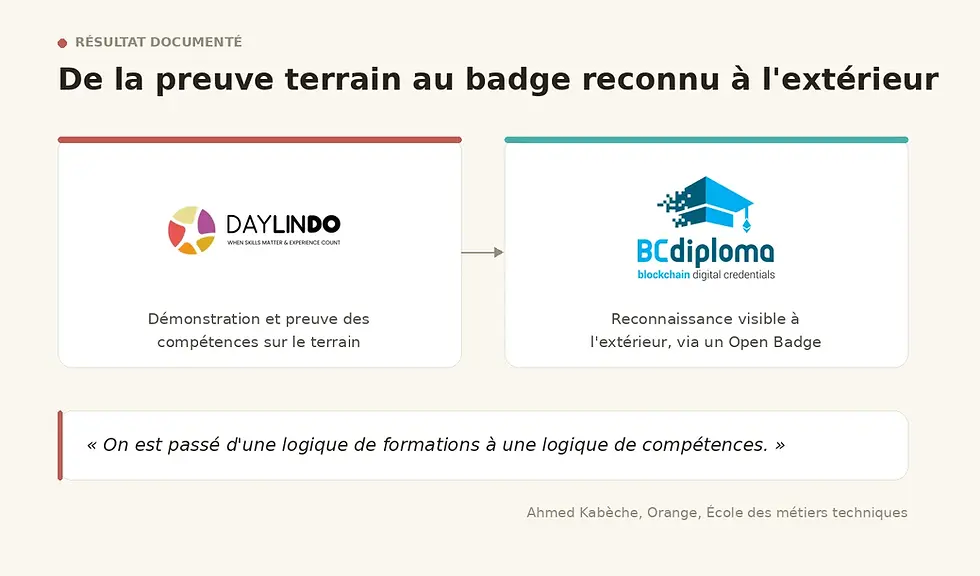
Orange followed this path for its technical training program. As Ahmed Kabèche, Director of the École des Métiers Techniques, puts it:
“We moved from a training-based approach to a skills-based approach.”
What makes a transversal skill usable rather than just a declared quality
In real work, transversal skills are not a category separate from technical skills. The two combine to make it possible to carry out the activities expected in a position. The goal is not to draw up an exhaustive list of transversal skills.
It is to identify those that are actually used in the company, describe them in specific work situations, and define how their mastery can be observed by an on-the-job trainer rather than declared by the employee themselves.
Daylindo structures this approach from real work: building frameworks from the activities actually carried out, equipping on-the-job trainers, deploying skills at the workstation, and tracing validated skills. More than 6,000 employees have been supported with this approach, with a 40% reduction in onboarding time observed on the programs concerned.
FAQ
What are the most sought-after transversal skills in companies?
There is no universal official list. Work by France Stratégie and France Travail highlights communication, teamwork, organization, use of digital tools and adaptability. The most useful approach is to start from the company’s own work situations rather than impose a generic list.
What is the difference between transversal skills and technical skills?
A transversal skill can be used across several jobs or situations. A technical skill depends on the tools, standards and methods specific to a given activity. The two are usually activated together in the same work situation.
Are cross-functional skills and transversal skills the same thing?
Yes, in the vast majority of professional contexts, the two terms refer to the same concept.
What is the difference between transferable skills and transversal skills?
According to the CMVRH, a transversal skill can be used across different job families, while a transferable skill applies to several jobs within the same family. The boundary does vary from one framework to another.
How do you assess a transversal skill?
By linking it to an observable work situation and to criteria defined in advance. A practical exercise or direct observation by an on-the-job trainer makes it possible to see the expected behaviors, rather than relying on self-assessment.
From framework to proof on the job
Listing transversal skills in a framework is a first step. The real test comes afterwards: when you need to show that an employee truly masters them, in their position, and not just on paper. This proof is what most HR frameworks lack, because they are built from an office rather than from real work.
Daylindo structures this proof at the source. Frameworks start from the activities actually carried out. On-the-job trainers are equipped to observe and validate, rather than simply deliver content. Each skill, transversal or technical, is deployed on the job and traced with time-stamped, enforceable, verifiable proof.
Want to know what your teams truly master, not what they ticked on a form?
Daylindo supports this approach starting from real work: structuring frameworks, equipping on-the-job trainers, deploying skills on the job and tracing validated skills.
Talk to a Daylindo expert to build a framework based on your teams’ real work.