
About Daylindo
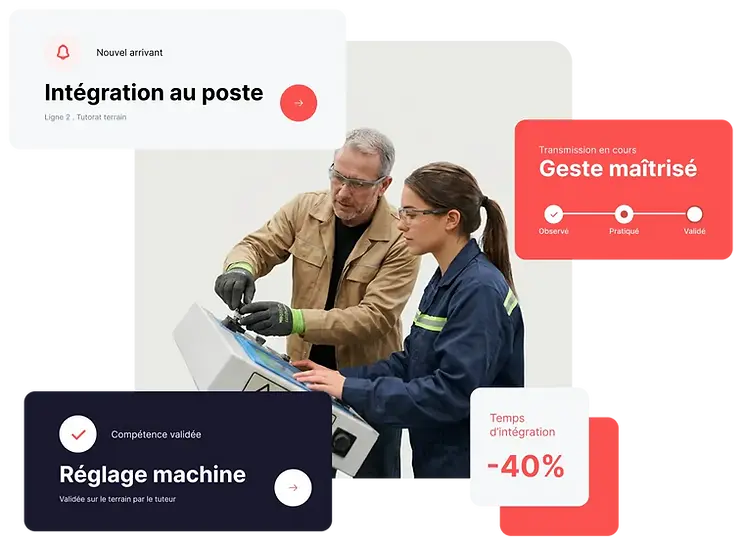
Our belief: Skills are also developed on the job
Every day, in companies, employees learn their jobs by doing, by exchanging ideas with their colleagues, and by solving real-world problems.
This learning is essential to organizational performance. Yet the skills developed in this way often remain invisible, underrecognized, and difficult to pass on.
It was this conviction that led to the founding of Daylindo in 2017: to better recognize the skills acquired on the job and facilitate their transfer between people.

An idea born from field observations
Before founding Daylindo, its founder, Gerardo Marcotti, spent fifteen years consulting on ways to improve companies’ operational performance.
This experience allowed him to observe a disconnect between traditional training practices and the way employees actually develop their job skills.
In manufacturing, as in many other sectors, mastery of a trade does not rely solely on acquired knowledge. It is also built through experience, repetition of tasks, observation, and knowledge sharing among colleagues.
At that time, training technologies were primarily designed to organize in-person sessions or deliver digital content. Few solutions allowed for the structuring of learning that took place directly at the workplace.
Daylindo was founded to address this need. As early as 2017, we began developing a platform to organize on-the-job learning and recognize the skills actually acquired.
The recognition of AFEST through the 2018 vocational training reform further reinforced this vision.
6 000+
Employees receiving support
5 years
R&D
-50%
Early turnover
-40%
Integration Periods
Our mission: to impart, develop, and master operational skills
Today, Daylindo helps companies pass on their expertise, develop their employees’ skills, and track their proficiency directly on the job.
We specifically target organizations for which job-specific skills are essential to the quality, safety, and performance of their operations.
Our platform enables companies to structure competency frameworks, organize on-the-job training, track employee progress, and maintain an up-to-date view of mastered skills.
This allows companies to better onboard new employees, support their professional development, and ensure the effective transfer of their expertise.

Technology combined with operational expertise
Experience has taught us that technology alone, even high-performance technology, is not enough to transform practices.
Companies also need methods, support, and tools that are easy to implement on the ground.
That is why we have gradually developed, around our SaaS platform, a suite of services covering learning path design, skills mapping, mentor support, and operational deployment.
This allows us to provide our clients with technology they can use on their own, or to support them throughout the entire implementation of their skills development programs.
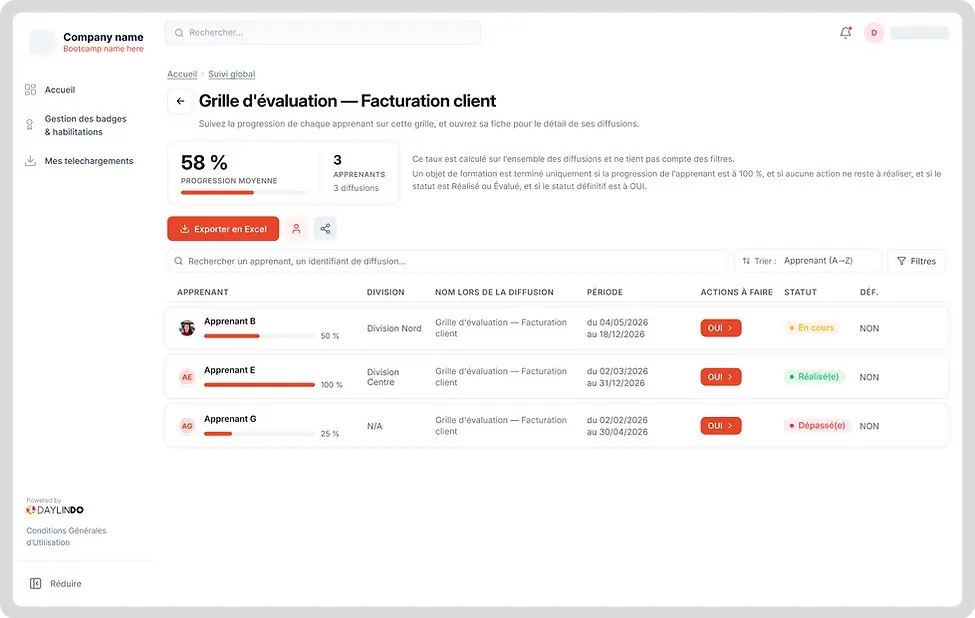
Innovation built together with our customers
Since our founding, our approach to innovation has been based on a close relationship with companies and their operational teams.
We observe best practices, engage with users, and work with them to build features that meet their actual needs.
The fact that we use our own platform to deliver training programs also allows us to assess its capabilities and limitations on a daily basis.
This close connection to the field guides our technology choices, particularly in the use of artificial intelligence to simplify the design, tracking, and assessment of skills.
“Our ambition remains the same as it was when we started: to ensure that the skills developed on a daily basis are no longer overlooked, but instead become a recognized asset that can be passed on and is beneficial to both individuals and the company.”